
 You can enjoy trekking the endangered mountain gorillas, chimpanzees or golden monkeys. Uganda also offers a unique opportunity of seeing the African Big five (lions, leopards, rhinos, buffaloes and elephants). You will also get the chance of getting firsthand encounters with diverse cultures and get to learn their unmatched legacies.
Gorilla trekking in Uganda
Uganda has approximately a half of the total mountain gorilla population in the entire world. Bwindi Impenetrable National Park alone has about 459 mountain gorillas and 23 habituated gorilla families. Mgahinga Gorilla National Park, the other destination where you can see these endangered primates has a single habituated gorilla family. These great statistics offer reliable gorilla treks throughout the year. All you have to do is acquire your gorilla permit in advance, through a reputable tour operator like us.
Uganda’s rich history
Come and explore a Uganda that has passed through periods of complex social, political and economic changes throughout its recorded history. You will gain extensive knowledge regarding how the changes have shaped the local people’s lifestyles and ideologies. You will notice how our forefathers’ political powers evolved after the coming of the British Administrators during colonial times. This is also your chance to learn about the changes in infrastructure, architecture, transport, religion and education among other elements.
Uganda’s recent history is equally interesting as you get the golden opportunity to learn about the country’s journey to independence on October 9, 1962 and after. In addition, you will learn about how the country became under the leadership of a president. Currently, Uganda’s president is H.E. Yoweri Museveni Tubuhaburwa. There was a period of political turmoil, which is still considered as the darkest Uganda has ever experienced. This was during the 1970s when Uganda was under the leadership of President Idi Amin Dada.
Culture and people of Uganda
 You can have a unique opportunity to visit various places, including the National Museum, Buganda Kingdom, Tooro Kingdom, Bunyoro Kingdom etc. This is an opportunity provided by Uganda for you to learn about the different tribes that make up the country. You will learn about how different people settled where they did. You will see the tools they used during hunting, farming, construction and other activities. You will also learn about their ethnic groups, customs and architecture.
Uganda has four main ethnic groups,the Bantu, Hamites, Nilo-Hamites and Nilotics. These cover various tribes, each with unique languages and cultures. The tribes include Baganda, Banyankole, Bagisu, Langi, Karimojong, Lugbara, Acholi, Basoga, Jopadhola, and Batooro. Their history will offer insight into how different communities were effectively governed through chiefs, kings, clan leaders etc. The cultural practices will offer you great experiences. These include circumcision, traditional dances, dressing, hunting and marriage ceremonies.
Best National Parks in Uganda
Out of the 734 protected and conservation areas in Uganda, there are 10 areas designated as national parks, 12 sites designated as wildlife reserves, 10 sites designated as wildlife sanctuaries and 5 community wildlife areas.
 Queen Elizabeth National Park
This spans around 1,978 km2 in southwestern Uganda. It became a national park in 1952 and is the most popular in Uganda. Queen Elizabeth National Park is known for the unique tree climbing lions. Queen Elizabeth National Park is also known for its diverse range of flora and fauna species. These include 95 mammal species, 600 bird species and 14,000 plant species. You will have a high chance to see mammals like 4 of the African Big five of lions, leopards, elephants and buffaloes. Other mammals are topis, Uganda kob, hippos and warthogs etc.
Bird species to find here include papyrus gonolek, grey crowned crane, shoebill stork, African fish eagle, African finfoot, swamp flycatcher, palm-nut vulture, martial eagle, collared pratincole, white-naped pigeon, African skimmer, great blue turaco, black bee-eater, yellow throated cuckoo and grey crowned crane. Reptiles in Queen Elizabeth National Park include Nile crocodiles, monitor lizards, and common house lizards among others. There are 10 primate species including chimpanzees, blue monkeys, L’hoest’s monkeys, pottos, and vervet monkeys.
Bwindi Impenetrable National Park
Bwindi Impenetrable National Park is a UNESCO World Heritage site found in southwestern Uganda. Gazetted in 1991 as a national park, Bwindi covers around 321 km2. The park is renowned for being home to over 450 mountain gorillas. Currently, there are 23 habituated gorilla families that are available for you to track throughout the year. Bwindi is also a home that shelters 11 primate species, including the mountain gorillas. Others are vervet monkeys, black and white colobus monkeys, red-tailed monkeys, olive baboons and chimpanzees etc.
There are also 357 bird species that find shelter in Bwindi, including numerous Albertine endemics. These are the Rwenzori turaco, bush shrike, Rwenzori batis, blue headed sunbird, white bellied robin chat, African green broadbill, mountain masked apalis, African harrier hawk, handsome spurfowl and regal sunbird etc. There are also numerous flora and fauna found here. There are mammals like buffalos, elephants, duikers and others. You will also see the butterflies, trees, herbs, grasses, amphibians and reptiles etc.
Murchison Falls National Park
Murchison Falls National Park is another prime tourism hotspot you will enjoy. This is the largest national park in Uganda, spanning 3,893 km2 in northwestern Uganda. It become a national park in 1952, getting its nice name from the great Murchison Falls. This is the most powerful waterfalls you will ever see. This is along the River Nile, which divides the park into 2. There are plenty of unique fauna and flora that find shelter in Murchison Falls National Park. Among them are over 76 mammal species and 476 bird species.
The mammals you will most likely see include 4 of the African Big Five, hippopotamuses, hyenas, Uganda kobs, oribi, Jackson’s hartebeest, waterbucks, bushbucks, giraffes, olive baboons, bush babies, warthogs and Bohor reedbuck etc. Birds include the shoebill stork, saddle billed stork, yellow wagtail, Abdim’s stork, black crowned crane, hooded vulture, Ruppell’s vulture, Egyptian vulture, goliath heron, grey crowned crane and the Abyssinian ground hornbill.
Kibale National Park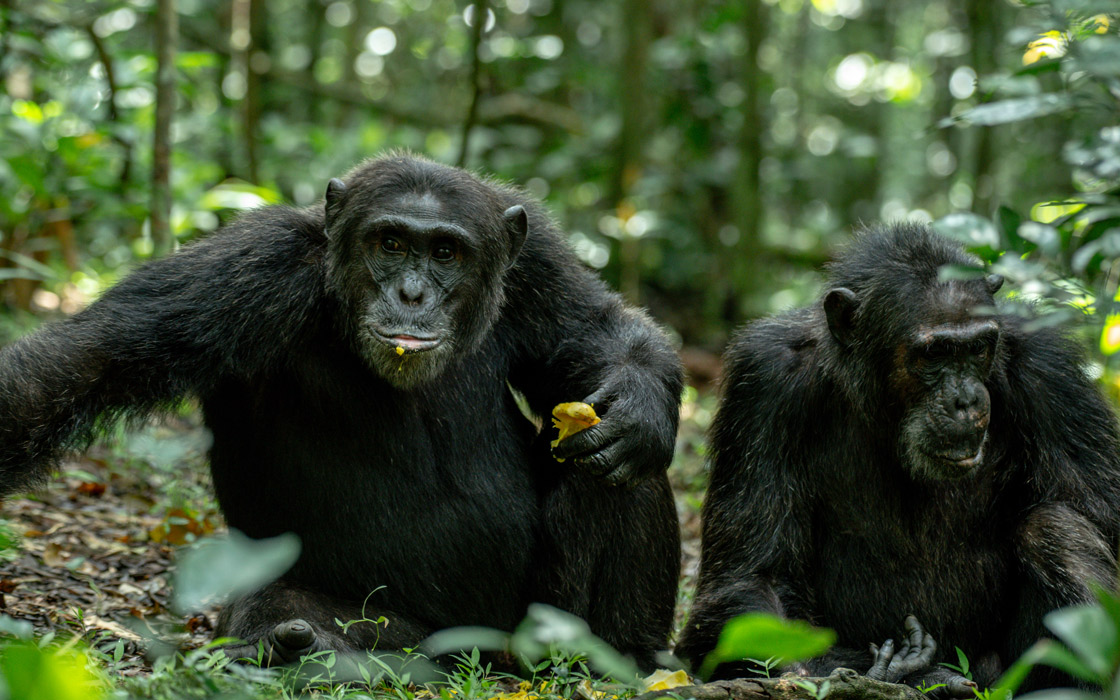
Kibale National Park spans 795 km2 in southwestern Uganda and has the largest population of chimpanzees. It became Kibale National Park in 1993 and this is due to a variety of factors, including being a biodiversity hotspot. Kibale National Park has 71 mammal species, 372 bird species and 350 tree species. Mammals include buffaloes, elephants, giant forest hogs and African civets. Birds include collared apalis, dusky crimson wing, purple breasted sunbird, blue-headed sunbird, African pitta, black bee-eater and the endemic Kibale ground thrush.
Among the mammals, there are 13 species of primates including the chimpanzees. Kibale National Park houses an estimated 1,450 chimpanzees, the biggest number in Uganda. Other primates include Uganda mangabeys, grey-cheeked mangabeys, L’hoest’s monkeys, black and white colobus monkeys, olive baboons, red colobus monkeys, bushbabies, red-tailed monkeys, mantled guerezas, pattas monkeys, pottos and vervet monkeys etc.
Apart from the above national parks, you can also choose to visit Kidepo Valley National Park, Lake Mburo National Park, Mgahinga Gorilla National Park, Semuliki National Park, Katonga Wildlife Reserve, Pian Upe Wildlife Reserve, Kyambura Game Reserve, Kabwoya Wildlife Reserve Ziwa Rhino Sanctuary, Mabira Forest, Mabamba Wetland Sanctuary, Uganda Wildlife Conservationa and Education Center, Ngamba Island Chimpanzee Sanctuary and Matheniko Wildlife Reserve.