
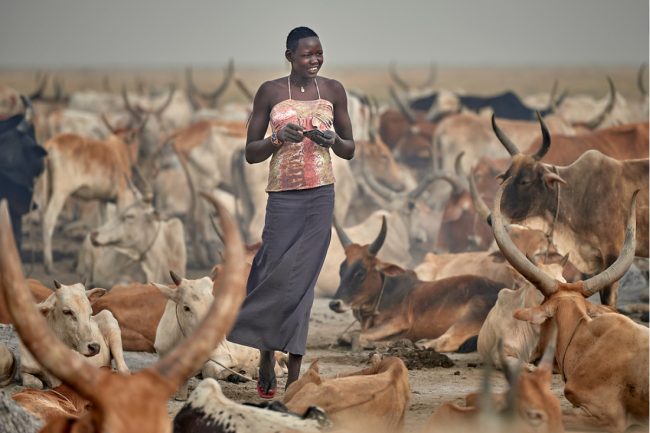
The Dinka tribe, situated in South Sudan, is arguably the largest ethnic group or tribe in the country. This is attributed to the number of people subscribing to the Dinka tribe, over 4.5 million in number, as per the 2008 South Sudan national census. The Dinka tribe is part of the Nilotic group of people that settled in the south and western regions of the White Nile in the modern-day South Sudan.
By physical appearance, the Dinka people are among the tallest people on with many of them growing up to 6.5 feet to 6.8 feet. This is because of their high protein content in their bodies, attributed to the cattle products they consume. The terrain of their land, being relatively flat, favours their height and increases adaptability to this particular terrain.
Brief history
Before the splitting of South Sudan from the main country, Sudan, the Dinka tribe faced persecution from the central government in Khartoum. This is mostly because of the Khartoum Islamicization campaigns that aimed at spreading Islam across the country by the central government. The Dinka people at this time were not ready for Islam, as most of them were Christians, and others practised traditional and cultural beliefs of worshipping their traditional god called Nhial.
The Khartoum government further went on to fund and promote civil wars among the tribes of Nuer and Dinka. This created massive killings and destabilization for many years. The imposition of Islamic law by the Khartoum government on the non-Muslim south further intensified as the government supported the Arab militias who targeted the customary and traditional tribes like the Dinka. This resulted in the shooting and killing of many men, enslaved women, and children. All this unrest took a huge toll on the Dinka tribe for many years until the split of South Sudan from Sudan, resulting in independence in 2011. The signing of some of the peace treaties, like the Comprehensive Peace Agreement signed in 2005, aimed at stopping the ethnic wars in the south.
Culture of the Dinka people
Traditionally, the Dinka people are farmers, mainly nomadic pastoralists, and also partly cultivators, making them agro-pastoralists. The local language spoken by the Dinka people is also called Dinka. The Dinka rear a particular type of cattle, the Ankole long-horned cattle, native to the land. These people move for longer hours in search of pasture and water for their animals. Their nomadic practice is caused by the need to find food and water for their cattle since their land is prone to drought, which leaves the land dry.
The herding and grazing of their beloved cattle is a responsibility of the able-bodied men and young boys. As the boys mature into men, they are taken through a series of teachings by the elders to prepare them for maturity. Their swift change to adulthood is seen through traditional practise as they abandon their role of milking, which is gazetted from the boys. The Dinka people form temporary cattle camps away from their permanent homes, which are taken care of by the women.
With changing times, the Dinka people introduced the hump-backed cattle, which replaced the previous humpless cattle that they had. This type of cattle became significant to the Dinka people due to its persistence in drought and other factors, such as moving for longer distances. With other tribes in the area having humpless cattle, this made the Dinka popular and more advantageous among the other tribes.
The cattle husbandry or cattle rearing among the Dinka people is largely not for commercial gains, but for cultural significance through bride wealth for marriages. As young men in the Dinka tribe mature for marriage, a hefty bride price is often demanded from the family of the girl. This is why having cattle is very important, and thus, for young men is a must-have. Each family in the Dinka tribe often cultivates up to two hectares of land with crops like sorghum, cow peas, and others. These crops are mainly for food, as the cattle among the Dinka are not raised for meat. The surplus of the produced crops is sold or exchanged for cattle, and in modern times, it supplements the cattle as bride wealth or bride price.