
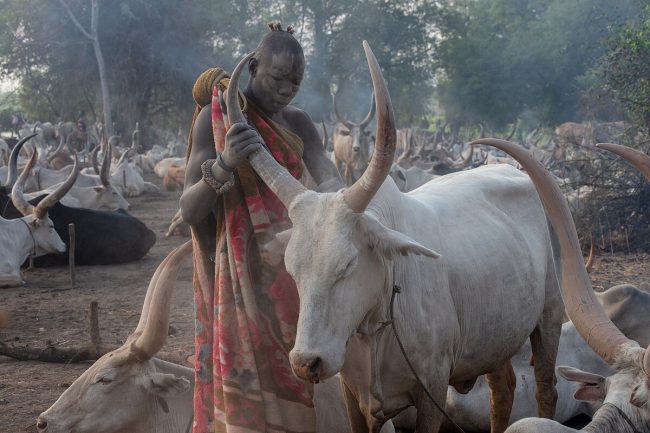
When it comes to cultural tours in South Sudan, the Mundari tribe is often mentioned many times. The Mundari people of South Sudan have managed the impossible by preserving their ancient culture even in the modern era. This is highly attributed to their love for their cattle. The Mundari people are centered on cattle, and their entire life is dedicated to their livestock. The Mundari treasure their cattle as it is the main source of wealth and prestige in their communities.
The history of the Mundari people of South Sudan extends far beyond the migration of the Bantu. Prehistorically, the Mundari people settled in the areas close to the White Nile as they are of the Nilotic descent. These people of Mundari are part of the nomadic pastoralists group who often move with their livestock, searching for pasture and water. This generally explains why they have temporary cattle camps.
The Mundari people rear a species of the Ankole long-horned cattle that are common to many parts of the cattle corridor in Uganda and a few areas in Rwanda. The Ankole-Tutsi long-horned cattle originated over 2,000 years ago after a breeding of the Egyptian long-horned cattle and the Indian Zebu. This combination formed the larger Sanga cattle group in Africa, where these Ankole-Tutsi long-horned cattle originate.
The world sometimes paints the Mundari people as violent since they possess assault weapons like AK47s. However, these weapons are mainly used for the protection of the cattle and defense from other rebel threats. It is worth noting that this area of South Sudan has seen unimaginable civil wars and political instability for many years. With the presence of wars, weapons have become very accessible even to the local people. Traditionally, the Mundari would use spears, bows, and arrows to protect their cattle, but with the introduction of modern, sophisticated weapons, the Mundari have thus shifted to assault weapons.
The Mundari people of South Sudan face a huge problem of cattle rustlers who raid their camps to steal their cattle. The Turkana of Kenya are fond of this habit, often attacking the Mundari when they least expect it. With these threats, the Mundari obtained arms for protection against these rustlers.
Significance of cattle in the Mundari people of South Sudan
It is quite hard to measure the love the Mundari people of South Sudan have for their cattle. They go as far as risking their lives or even death for these cows. As the world may see these cattle as just other animals, the Mundari people treasure them as much as they treasure humans. This is why they never eat their cattle. In the Mundari tribe, the cattle are seen as the only source of wealth, prosperity, and power. This is why every man or family of the Mundari would do nothing to have cattle. Social respect and position are measured by the number of cattle one possesses and also the size and shape of the horns.
Cattle in the Mundari tribe are a lifeline for the mature men to have a family. This is because the cattle are given to the family of the girl as bride price. The average bride price in the Mundari tribe is 20-30 cows, but sometimes it increases to 40 cows depending on a few factors. With different families setting a peak for the number of cattle for a price, this has increased the hunt to own more cattle. This alone has led to many ethnic wars between different tribes in the region in the form of cattle raids.
The cattle provide milk for the Mundari people to drink, which is often mixed with the cattle’s urine. The Mundari sometimes carefully spear the neck area of the cow and collect blood, which is also mixed with the milk. The urine from the cattle is also used for cleanliness, as it is collected for bathing and cleaning the utensils.
The Mundari cattle camp
The Mundari cattle camp is like a temporary homestead where the Mundari people live with their cattle. These cattle camps of the Mundari do not have permanent structures, given the nomadic nature of nomadism caused by the shifts in weather. The areas of Terekeka were the Mundari people are mostly located are generally flat with a clay-type soil. This soil has poor water retention and often causes flooding in the rainy seasons or when the White Nile floods. This is also why it is prone to strong drought in the dry months.
Inside the Mundari cattle camps, everyone has a responsibility aligned with their cattle. Every morning, the men are responsible for milking and taking cattle out for grazing for the whole day. At dawn, as the men leave with the cattle to graze, the women clean the camp as they settle to prepare food. The children also clean the camp and spread the cow dung for drying. At sunset, they collect and heap the dung for burning in the night.
The burning dry dung is very important in the Mundari culture as the scent of the burning dung chases away the flies, especially mosquitoes, thus giving them a good night’s sleep. Early morning, the ashes from the burnt dung are smeared on the cattle as an antiseptic to prevent ticks and also protect them from the sun. The Mundari also mix this ash with the cattle urine and smear it on their bodies for similar advantages.